Companions at Gallery FUMI: A Second Life for the Humble Shingle
Lukas Wegwerth and Corinna Dehn’s new London exhibition starts with an ordinary building element. Its lesson for makers lies in how a material can guide both form and collaboration.
Oct 10, 2026 · 3 min read
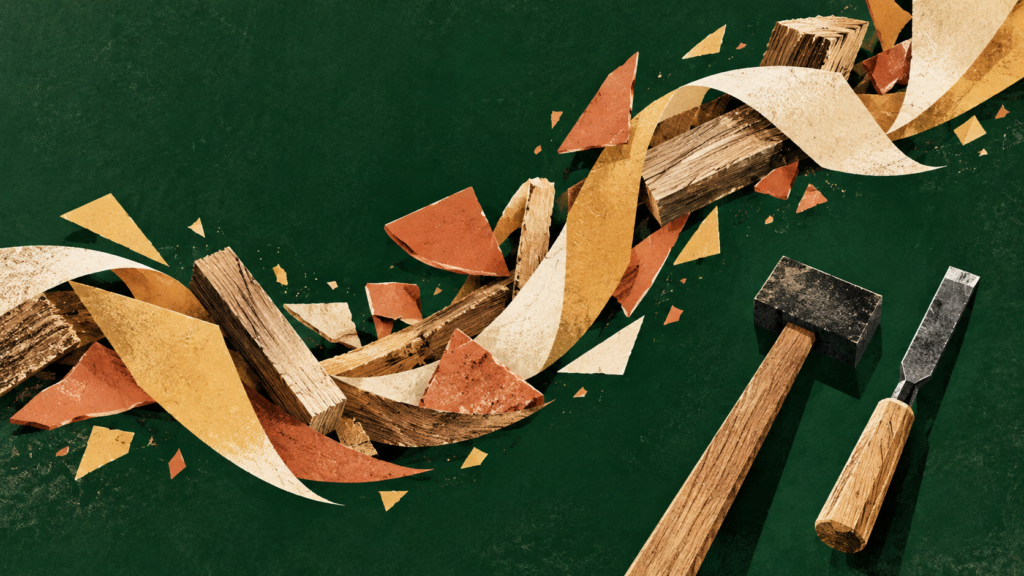
A humble building element can carry an entire design idea. In Companions, Lukas Wegwerth and Corinna Dehn develop furniture around the overlapping shingle, drawing attention to the relationship between a structure and the smaller pieces that cover it.
Gallery FUMI’s exhibition page lists the show in Mayfair, London, from October 6–November 21, 2026. This discovery feature uses the gallery’s published account; it does not claim a studio visit or firsthand inspection.
We selected this collaboration for its specific material process, clear account of shared making and useful connection between everyday architecture and collectible design. This is one researched example, not a ranking of sustainable furniture.
The detail becomes the design system
The gallery describes an evolution of the pair’s Armadillo series, with objects including cabinets, a chair, a dining table and a birdhouse. Its account traces their interest in shingles to renovating their home and studio in Germany’s Vogelsberg region and salvaging cladding.
The compelling idea, in our view, is repetition with variation. A small component can set the rhythm of a much larger object. That gives a maker a different starting question: what can this unit do when repeated, turned or made denser?
This approach is useful beyond furniture. A clothing designer might study how a seam changes across a garment; a graphic designer might test what one mark can become across a page. Those are our suggested exercises, not activities attributed to the pair.
Materials have histories, but claims need boundaries
According to FUMI, the exhibition uses shingles and timber with earlier lives in buildings and other objects. The gallery also describes individual staining or painting and an ebonising process involving wood tannins and iron.
The specific account is more useful than calling everything “eco-friendly.” It tells a reader what was used and how it was worked. It does not establish a measured carbon saving, a complete lifecycle assessment or a general answer to the environmental impact of collectible design.
That distinction matters for makers communicating their own work. Describe the reclaimed material, its source where known and what you did with it. Let the detail carry the story rather than asking a broad sustainability label to do all the work.
Collaboration belongs in the object’s explanation
FUMI describes joint planning and prototyping, with Dehn shaping, sanding and pigmenting shingles while Wegwerth develops the supporting structure. They then apply the shingles together.
A useful way to read that process is as a conversation between surface and support. Each needs the other to become the finished object. Naming both makers makes the collaboration easier to understand.
Wegwerth’s gallery profile places found organic materials and transformation within his broader practice. Dehn’s own FUMI page offers a direct route to her listed work. Follow both rather than treating one partner as background.
A small exercise for your own practice
Choose an ordinary component you normally ignore: a fastening, tile, scrap or packaging insert. Draw three arrangements without turning it immediately into a finished product. Then identify which features must stay consistent and which can vary.
If working with someone else, discuss who develops the structure, who changes the surface and where you need to make decisions together. The exercise is not about reproducing Armadillo. It is about letting a material lead you toward a more specific question.
For a wider London art context, explore Le Cadre’s Frieze Focus story.
What material are you trying to understand better? Share a test or work in progress in Le Cadre’s Visual Art community.