Frieze London 2026 Focus: Three Artists Making Everyday Materials Matter
Ahead of Frieze London, three planned Focus presentations offer a way into the fair through recycled textiles, painting in a domestic setting and playful sculptural scale.
Oct 9, 2026 · 3 min read
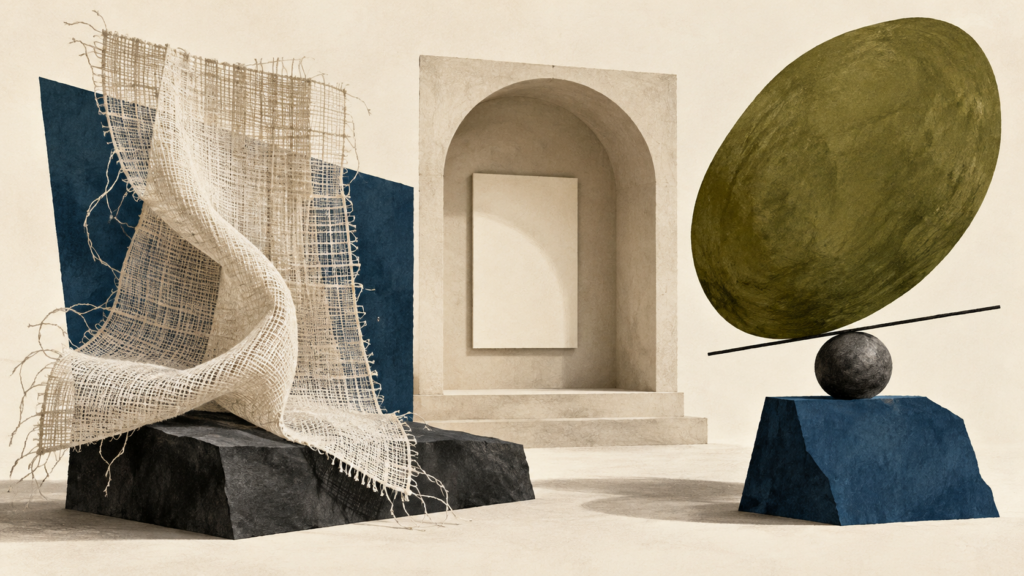
For a manageable route into Frieze London’s Focus section, follow the materials rather than trying to identify the next big name. Jayeeta Chatterjee, Tamo Jugeli and Steph Huang offer three different ways to look at everyday surroundings: through textiles, a room built around paintings and sculpture that changes the scale of familiar objects.
Frieze London runs October 14–18, 2026, in The Regent’s Park. Its Focus announcement describes 35 presentations from young galleries. This selection is Le Cadre’s editorial route through that programme, not a prize ranking or a claim to have seen the installations.
Our criteria are specific: a documented planned presentation, a legible material or spatial approach, and a useful question for creators beyond the fair. The connecting idea is what happens when familiar things become a way of thinking.
Jayeeta Chatterjee: cloth with a working life
Frieze’s Focus preview says Chatterjee, presented by Chemould CoLab, will bring woodcut prints on recycled sari scrolls and Nakshi Kantha quilting, addressing the working lives of Bengali women.
That gives viewers something more precise to consider than “textile art.” Look at the relationship between a printed image and the cloth carrying it. What can a reused material contribute that a new, neutral surface cannot? Where does the making process remain visible?
Our reading is that the presentation offers a useful challenge to creators: treat the support as part of the meaning. The announced subject should not become a shortcut for assuming every detail of the women’s lives. Start with the work and the artist’s documented context, not a story invented for its texture.
Tamo Jugeli: painting inside a room
Bukia Vakhania’s own preview describes Jugeli’s booth as an intimate interior combining paintings, wallpaper and sculptural lighting. The gallery characterizes her painting through layered color, contours and sweeping gestures between abstraction and figuration.
For a viewer, the interesting question is how that room changes the paintings’ relationship to one another. A booth is usually treated as temporary display space. Here, the setting is part of what viewers are asked to encounter.
This also gives artists and designers a practical question to borrow: what changes when the surroundings are designed alongside the work? That does not mean every exhibition needs an elaborate set. It means the wall, light and distance between objects deserve conscious choices.
Steph Huang: a familiar object, an unfamiliar scale
Frieze’s September 15 press preview describes Huang’s planned Public presentation as sculptural work on a steel bar cart, including oversized olives on a large metal toothpick.
The ordinary reference provides a foothold before interpretation. Then scale makes it strange. Our interest is in that sequence: recognition first, a second look afterward. Humor can invite attention without requiring the viewer to know an artist’s complete history.
Take a question with you
These are announced presentations, not finished-installation reviews. Check the latest fair and gallery information before planning a visit; access arrangements and displays can change.
Whether you visit or browse the official previews, compare three choices: the surface carrying an image, the room surrounding it, and the scale of an object. That is a more useful creative exercise than trying to see everything.
For a related look at how place shapes artwork, read Le Cadre’s New South, Ground Truth feature. Then share a material or technique you are experimenting with in the community.