Artist Bio vs. Artist Statement: Write the Right One for the Opportunity
An artist bio explains who you are professionally. An artist statement explains what the work is doing. Use this guide and adaptable templates to write each one clearly.
Oct 15, 2026 · 3 min read
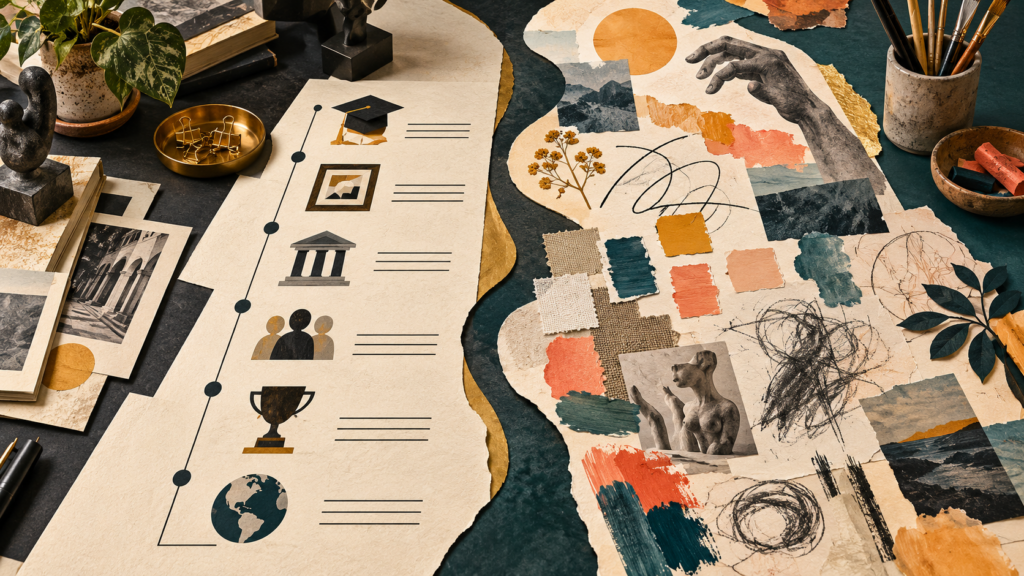
An artist bio explains who you are professionally. An artist statement explains what your work is doing and why. They may appear beside the same portfolio, but they answer different questions. Treating them as interchangeable usually produces a document that is too personal to function as a bio and too résumé-like to illuminate the work.
The useful approach is to build one strong core version of each, then adapt it to the opportunity. A residency panel, exhibition visitor and website reader do not need identical information.
The difference in one glance
| Document | Main question | Typical voice | Best evidence |
|---|---|---|---|
| Artist bio | Who is this creator? | Third person | Discipline, location, selected achievements, current work |
| Artist statement | What is the work doing? | Usually first person | Materials, process, ideas, choices and context |
New York Foundation for the Arts makes the distinction plainly: a bio covers factual experiences and accomplishments, while a statement addresses the conceptual and aesthetic choices behind the work. Mid-America Arts Alliance similarly describes the bio as a concise professional narrative rather than a CV.
Build the bio from five useful sentences
A reliable short bio can be assembled in this order:
- Identity: name, discipline and location or working context.
- Practice: the materials, forms or questions that make the work recognizable.
- Selected proof: one or two relevant exhibitions, releases, awards, clients, publications or performances.
- Current direction: a project, body of work or role that shows where the practice is going.
- Useful context: education, community work or another detail only when it strengthens this version.
Mid-America Arts Alliance recommends developing a 150–200-word primary bio, then making 100- and 50-word versions. Those are practical working lengths, not universal rules; the application’s limit always wins.
Adaptable bio template: “[Name] is a [discipline] based in [place/context]. Their work uses [materials or methods] to explore [specific questions]. Selected work has been [shown, released, published or supported] by [relevant examples]. They are currently [current project or direction].”
Make the statement point back to the work
Start with one piece that represents the practice. Describe what a viewer, listener or participant encounters. Then explain the decisions underneath it: Why these materials? Why this structure? What question keeps returning? What does the process allow you to notice?
NYFA advises direct language, concrete sensory description and a clear connection between the statement and submitted work samples. It also recommends maintaining longer and shorter versions—around 500 and 150 words—as a way to edit for different limits.
Statement starter: “I make [form of work] using [materials/process]. In [specific project or recurring approach], I [observable action]. This allows me to examine [question or tension]. I want the audience to [encounter, notice or reconsider something specific].”
Remove the sentences that are doing no work
Cut childhood origin stories unless they are essential to the current practice. Replace claims such as “my work is unique” with the choice that demonstrates the difference. Define necessary specialist language. Do not force a trending social theme onto work that does not support it.
Finally, read both documents beside the portfolio. The bio should make the creator legible; the statement should make the work more available without explaining away its mystery. Le Cadre’s independent artist EPK checklist and photography portfolio guide can help place those texts inside a broader professional package.