Six Building Bridges Fellows Expanding the Frame of U.S. Muslim Stories
The new Building Bridges fellowship cohort spans documentary, fiction and installation. Its six projects show why support for representation must also support different forms.
Oct 11, 2026 · 2 min read
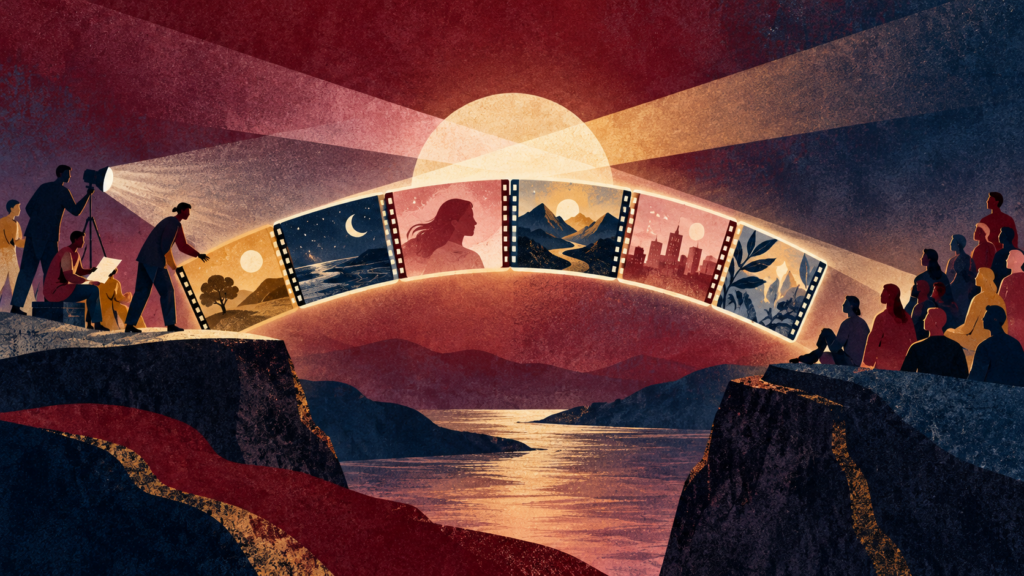
Representation becomes more meaningful when creators have room to tell different kinds of stories. The 2026 Building Bridges Fellowship cohort brings together six filmmakers working across documentary, fiction and installation, with projects that approach U.S. Muslim experience from distinct angles.
Sundance Institute announced the cohort on October 6, 2026. The program is run with the Islamic Scholarship Fund and funded by the Doris Duke Foundation.
Le Cadre selected this cohort for discovery because the published project list demonstrates formal range, not because six biographies can stand in for an entire community. The descriptions below are based on the organizers’ announcement, not interviews or screenings.
Six projects, several ways into identity
Aiman Mimiko is developing Native Authority, with Sundance describing his work as concerned with faith, power and belonging across Muslim and African worlds.
Mariam Dwedar’s project is The Farewell Kiss. Her background spans documentary, television and news, a mix that can bring both reporting discipline and cinematic judgment to a story.
Mohammed Ali Naqvi is working on A Life on Terror. His record crosses documentary and fiction, including Hanging by a Wire, which the announcement says premiered at the 2026 Sundance Film Festival.
Mustafa Rony Zeno’s Please Take Off Your Shoes arrives from a practice that moves among narrative, documentary, commercial and installation work.
Nimco Sheikhaden is directing The Angriest Black Man in America. Sundance describes her work as exploring systemic neglect, media distortion, and Black and Muslim resilience through intimate observation.
Ward Kamel’s project is If I Die in America, a short the announcement says premiered at SXSW. His feature script EQUITY placed second on the 2025 Black List, according to the same source.
These short descriptions establish subjects and backgrounds, not conclusions about unfinished projects. Readers should follow the filmmakers’ official work as fuller materials become available.
Support should match the length of the process
The fellowship includes an unrestricted artist grant, yearlong mentorship, professional development, a Sundance Collab package, a tailored festival experience and access to Sundance’s ELEVATE program. The fellows are also scheduled to convene at Duke Farms in October.
That combination is worth noticing. A grant can buy time, but a film also needs feedback, relationships, production strategy and a route toward audiences. One showcase cannot provide all of that.
Our view is that the program’s strongest idea is continuity. Representation is often discussed as an image on a screen; here, it is also infrastructure around the person making it.
Discovery comes with responsibility
A cohort announcement is an invitation to pay attention, not a substitute for watching the finished work. Audiences and editors should avoid collapsing these filmmakers into one “Muslim story.” The projects’ different titles, forms and creative histories already argue against that shortcut.
For creators looking at fellowship programs, the lesson is practical: describe the specific project and the support it needs. A clear creative question is more useful than trying to represent every possible experience at once.
For a wider conversation about creative community and film discovery, read Le Cadre’s London Film Festival story.
Which emerging filmmaker or unfinished project are you following—and what made you pay attention? Join Le Cadre’s Film & Video conversation.