Dreamtime in Newark Rebuilds the Memory of an Artist-Led Institution
Dreamtime in Newark traces Aljira’s 35-year history from an artist-led studio to a globally connected institution—and asks what creative communities preserve when a space closes.
Oct 15, 2026 · 3 min read
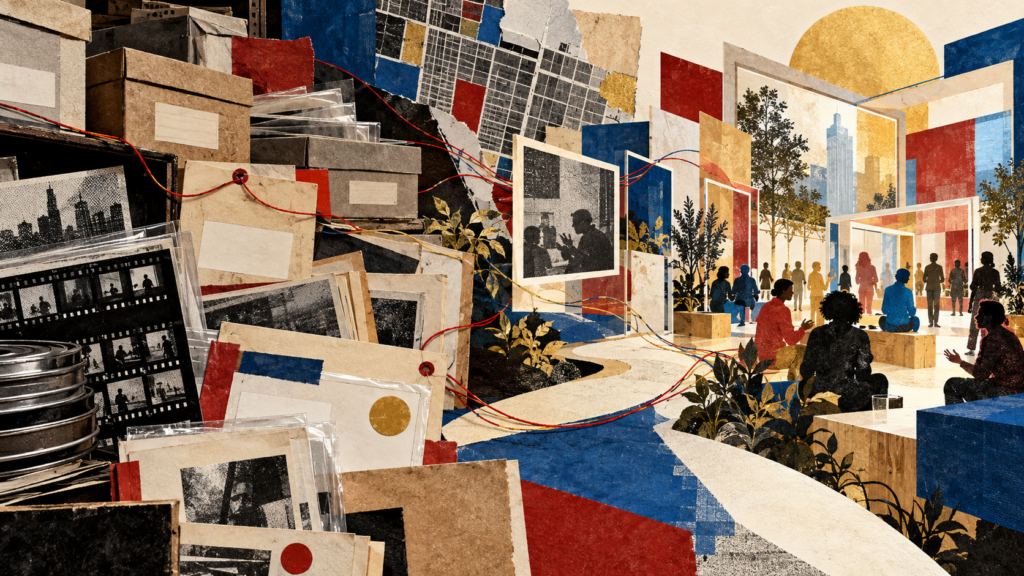
Dreamtime in Newark: Aljira and the Making of Global Contemporary Art treats an artist-led institution as something more than a vanished address. Opening with a book launch and reception on October 15 before welcoming the public October 16, the Newark Museum of Art exhibition reconstructs Aljira’s 35-year history through artworks, archives and the relationships that connected Newark to a wider art world.
The museum says the exhibition includes 46 local and global artists across multiple media. Its list moves between figures such as Dawoud Bey, Firelei Báez, El Anatsui, Mickalene Thomas, Willie Cole and artists deeply tied to Newark. Alliyah Allen and Tricia Laughlin Bloom curated the project in collaboration with the Aljira Archive Project.
An artist-led space became infrastructure
Aljira began in 1983 as an artist-led studio space and developed into a major contemporary arts institution before closing in 2018. Rutgers University Press, publisher of the accompanying open-access volume, attributes that closure to gentrification and financial pressure. Its description also emphasizes Aljira’s role in supporting marginalized artists and curators before institutional conversations about decolonizing the art world became commonplace.
Those are documented points from the museum and book materials. Le Cadre’s reading is that Aljira’s importance cannot be measured only by the exhibitions it mounted. Artist-led spaces also build informal infrastructure: introductions, early opportunities, arguments, audiences, mentorship and permission to attempt work before a larger institution understands it.
Local and global were never opposites
The exhibition’s subtitle—“the making of global contemporary art”—could suggest that recognition arrived only when Newark’s artists moved outward. Aljira’s history offers a more interesting possibility. A local institution can be globally significant precisely because it is accountable to a place and able to connect that place to wider conversations on its own terms.
That approach matters for today’s creative communities. “Global” reach often gets reduced to platform distribution. Aljira points toward a deeper exchange: artists, curators and ideas moving through relationships while a community maintains a center of gravity.
An archive is part of the creative practice
The Aljira Archive Project was founded after the institution closed, turning records into a resource for exhibition-making and historical study. The current project demonstrates why preservation cannot wait until a space is in danger.
An emerging collective does not need a museum-grade system to begin. It can keep dated exhibition lists, artist agreements, installation photographs, flyers, budgets, meeting notes and short accounts of how decisions were made. Permissions should travel with images and recordings. Files need more than one responsible keeper. The objective is not paperwork for its own sake; it is giving future people enough evidence to understand what the community built.
Legacy should remain usable
This article is based on published exhibition and catalogue materials, not an in-person review of the installation. Its strongest proposition is visible before entering the gallery: preserving an artist-led history can reconnect it to the city and artists that produced it, rather than freezing it as institutional nostalgia.
Le Cadre’s features on the Studio Museum’s artists in residence and four Atlanta artists exploring Southern landscape similarly show that creative ecosystems are carried by both individual practices and the structures that let those practices meet. Dreamtime in Newark makes the structure itself part of the story.