Christine Sun Kim Makes Sound Visible—and the MacArthur Fellowship Took Notice
Christine Sun Kim’s drawings, murals and installations turn sound and communication into visual systems. Her 2026 MacArthur Fellowship recognizes a practice that changes who gets centered.
Oct 14, 2026 · 2 min read
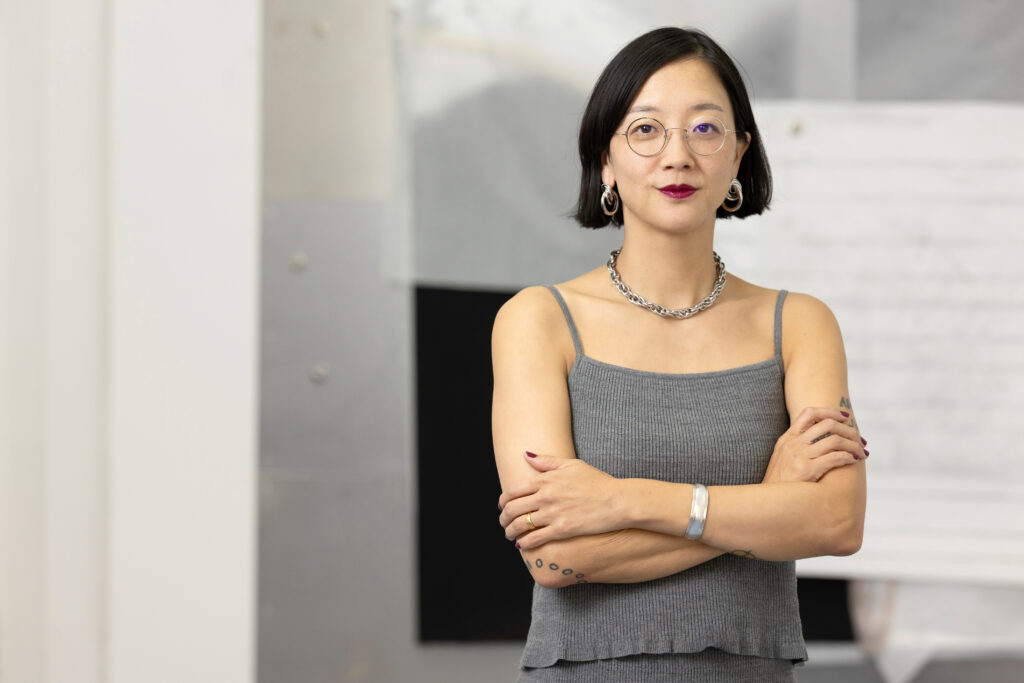
Christine Sun Kim has been named a 2026 MacArthur Fellow for an artistic practice that makes sound, language and communication visible—and exposes the power structures inside them. The award places her among twenty fellows receiving an $800,000, no-strings-attached fellowship, but the more useful introduction is found in how her work changes the terms of looking and listening.
Kim, who is Deaf, works across drawing, large-scale murals, video and interactive installation. The MacArthur Foundation describes her practice as exploring the political, cultural and multisensory dimensions of sound and spoken language. Rather than treating sound as the private territory of hearing people, she turns it into line, movement, notation, space and social negotiation.
Sound is never only sound
Musical notation appears frequently in Kim’s work, but it does not behave like a neutral instruction system. Notes can fall outside a staff, repeat, collide or refuse an expected pitch. These visual disruptions point toward what communication systems include, what they leave out and who is expected to adapt.
The official MacArthur profile highlights Ghost(ed) Notes, a 2024 mural in which musical notes appear around and beyond four-line staves. The image suggests rhythm while withholding a stable pitch. That tension is central to Kim’s practice: information can be present without being equally accessible, and communication can fail even when everyone believes a message has been delivered.
Access becomes a creative method
Disability is often discussed in cultural institutions as an accommodation added after the work is made. Kim’s practice offers a stronger proposition. Access can shape the form, pacing and politics of an artwork from the beginning.
That does not mean every project needs to imitate her visual language. It means creators can ask better questions: Who is assumed to be the default audience? Which sensory experience carries the “real” meaning? Does a caption merely repeat dialogue, or can it communicate tone, timing and atmosphere? Does an event invite participation while depending on one mode of attention?
This is Le Cadre’s interpretation, based on the documented work rather than an interview with Kim. The distinction matters because her art is not simply a design lesson about converting audio into graphics. It addresses the labor Deaf people perform when spoken communication is treated as universal.
Why the fellowship matters
The MacArthur Fellowship is unrestricted, meaning recipients are not required to deliver a particular project. For an artist whose work crosses gallery, public space, performance and communication systems, that freedom can be especially meaningful. It recognizes not one medium but a sustained way of thinking.
Kim’s selection also broadens the picture of what sound art can be. Le Cadre has previously considered collective listening through Tarek Atoui’s Tate Modern commission. Kim pushes the conversation elsewhere: toward the politics of audibility, the visual grammar of sound and the difference between being present and being included.
For creators, her work leaves a demanding question. When a medium seems natural—sound, speech, sight or text—whose experience made it feel that way?
Sources
Join the conversation: How is access changing the material or method of your own creative work?